
Case study
Building a Scalable Multi-Channel SaaS CRM Platform
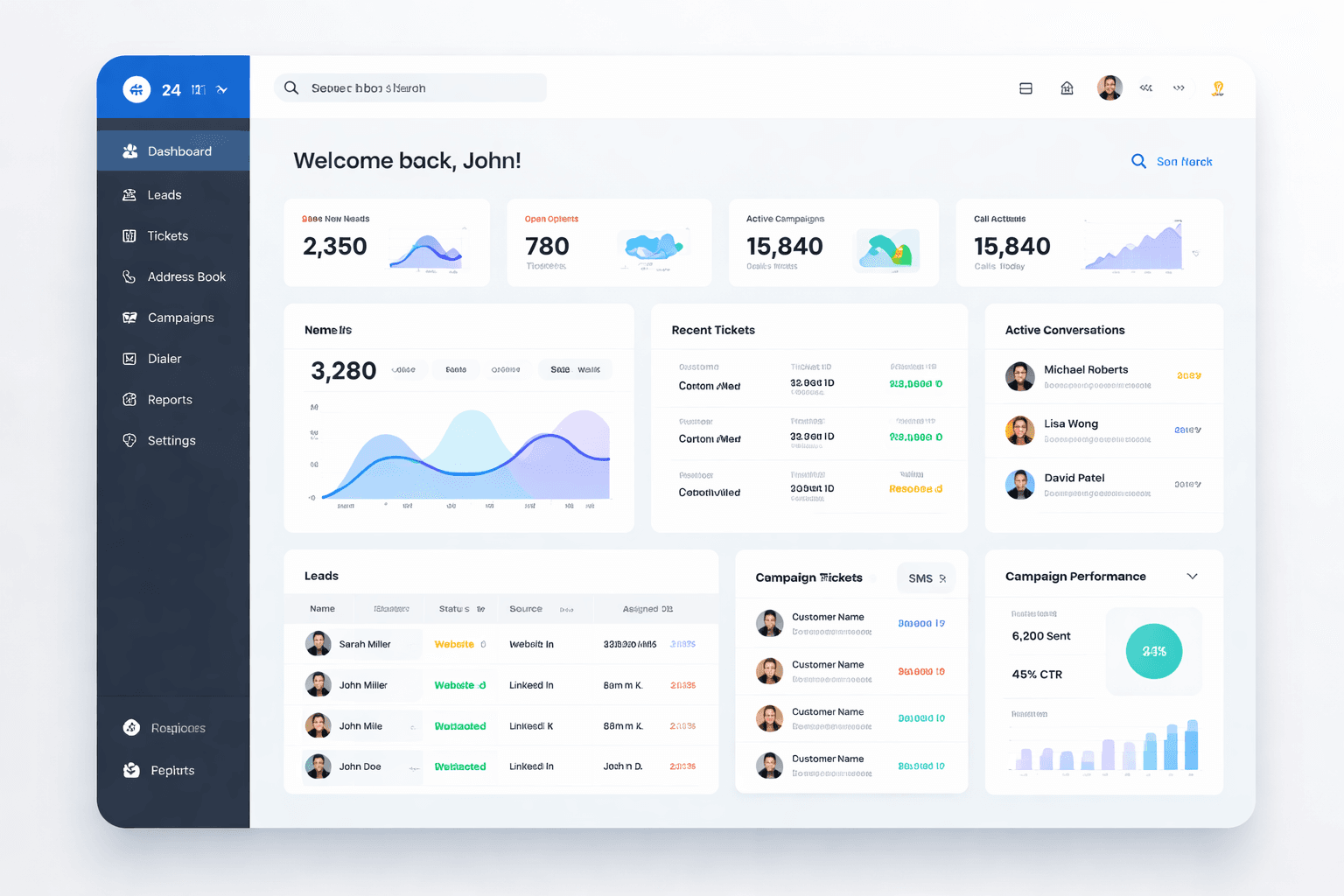
A scalable SaaS CRM platform designed to unify lead management, ticketing, and multi-channel communication (SMS, WhatsApp, Dialer) within a single ecosystem. Built on a modular, event-driven architecture, it enables real-time interactions, automated campaign execution, and seamless data flow across services. The system supports high-volume operations with optimized performance, low-latency messaging, and efficient state management. A dynamic form builder was introduced to streamline workflows and reduce code complexity, contributing to a more maintainable and extensible platform.
Overview
Building a Scalable Multi-Channel SaaS CRM Platform
Scope, timeline, and context—how the work was framed before a single sprint shipped.
Multi-tenant SaaS CRM built to centralize customer data, streamline operations, and enable real-time, multi-channel engagement. The platform integrates core modules like Leads, Tickets, Address Book, Campaigns (SMS, WhatsApp), and Dialer into a single, cohesive system, eliminating data silos and fragmented workflows. Designed with a modular, event-driven architecture, CRM supports high-throughput communication and scalable processing of customer interactions. Real-time capabilities powered by socket-based communication ensure instant updates across dashboards, campaigns, and support workflows. Background processing and messaging queues enable reliable execution of high-volume campaigns and dialer operations without blocking system performance. The platform emphasizes performance, extensibility, and maintainability, allowing new communication channels and features to be integrated with minimal friction. Alongside this, a dynamic form system standardizes data handling across modules, reducing redundancy while keeping the system flexible for evolving business needs.
Organization
Multiple
Duration
Ongoing
Project type
Web Application
Role
Full Stack Engineer
Case study
How we got there
From constraint to release: the problem, the approach, the build, and what changed after go-live.
The problem
Modern businesses relied on fragmented tools for lead management, customer support, and communication channels like SMS, WhatsApp, and calling systems. This led to data silos, inconsistent customer records, and inefficient workflows across teams. Agents had to switch between multiple systems, resulting in delayed responses, duplicated efforts, and poor visibility into the customer lifecycle. Handling high-volume communication was another challenge. Existing systems struggled with real-time updates, campaign execution, and dialer operations at scale, often causing delays, message failures, or system bottlenecks. Additionally, the lack of a unified and flexible data structure made it difficult to adapt to changing business requirements, leading to high development overhead and slow feature delivery. There was a clear need for a centralized, scalable, and real-time CRM platform that could unify operations, streamline multi-channel communication, and handle growing system demands efficiently.
The approach
The system was designed using a modular, service-oriented architecture to decouple core CRM domains like Leads, Tickets, Campaigns, and Communication channels. Each module was built as an independent unit with clearly defined responsibilities, enabling faster development and easier scalability. An event-driven approach was adopted to handle high-volume operations such as campaign execution, message delivery, and dialer activities. Message queues ensured asynchronous processing, improving system reliability and preventing bottlenecks during peak loads. For real-time requirements, socket-based communication was implemented to deliver instant updates across dashboards, conversations, and agent workflows, eliminating delays caused by traditional polling. A unified data layer was introduced to maintain consistency across modules, reducing duplication and ensuring a single source of truth for customer data. Additionally, a configurable form system allowed dynamic data handling without requiring frequent code changes. Performance optimization was prioritized through efficient state management, caching strategies, and optimized API design, ensuring low latency and smooth user experience even under heavy usage.
The solution
Delivered a unified SaaS CRM platform that consolidates Leads, Tickets, Address Book, Campaigns (SMS, WhatsApp), and Dialer into a single system, eliminating fragmented workflows and ensuring a consistent customer view. Implemented a real-time communication layer to provide instant updates across conversations, dashboards, and agent activities, significantly improving responsiveness and operational visibility. Built a robust campaign engine capable of handling high-volume SMS and WhatsApp workflows with reliable delivery, scheduling, and tracking, supported by asynchronous processing for stability at scale. Integrated a scalable dialer system to streamline outbound calling, automate call flows, and support high concurrency without performance degradation. Established a centralized data model to maintain data consistency across all modules, reducing duplication and enabling seamless cross-module interactions. Introduced a configurable form system to standardize data capture and reduce development overhead, while keeping the platform flexible for evolving business needs. Optimized the platform for performance and scalability through efficient state management, caching, and non-blocking operations, ensuring low latency and smooth user experience under heavy load.
Product views
Building a Scalable Multi-Channel SaaS CRM Platform
Interface moments that show hierarchy, density, and polish—the same bar we bring to stakeholder reviews.
Results
The result
Implemented solution delivered measurable improvements across system performance, operational efficiency, and user experience at scale.
The platform successfully unified fragmented CRM operations into a single, scalable system, significantly improving team efficiency and reducing operational overhead. Real-time communication and event-driven processing enabled faster response times and smoother execution of high-volume campaigns. System reliability and performance improved under load due to asynchronous processing and optimized architecture, allowing seamless handling of concurrent users, campaigns, and dialer operations without degradation. Operational workflows became more streamlined, with reduced dependency on multiple tools, leading to faster lead processing, improved ticket resolution times, and better customer engagement across channels. Overall, the solution delivered a scalable, high-performance CRM ecosystem that enhanced productivity, improved system stability, and supported rapid business growth.
System Consolidation
80% Reduction
Unified multiple standalone tools into a single CRM platform, reducing system fragmentation.
Codebase Optimization
~60% Less Redundancy
Eliminated repetitive logic through modular architecture and reusable components.
Campaign Throughput
High-Volume Processing
Supported large-scale SMS/WhatsApp campaigns with stable asynchronous execution.
System Reliability
Near Zero Blocking Operations
Event-driven architecture ensured smooth handling of peak loads without failures.
Next step
Want a build like this?
We scope in milestones, ship in slices, and keep communication crisp—so your roadmap stays honest.