
Case study
Improving Data Accuracy in IRIS
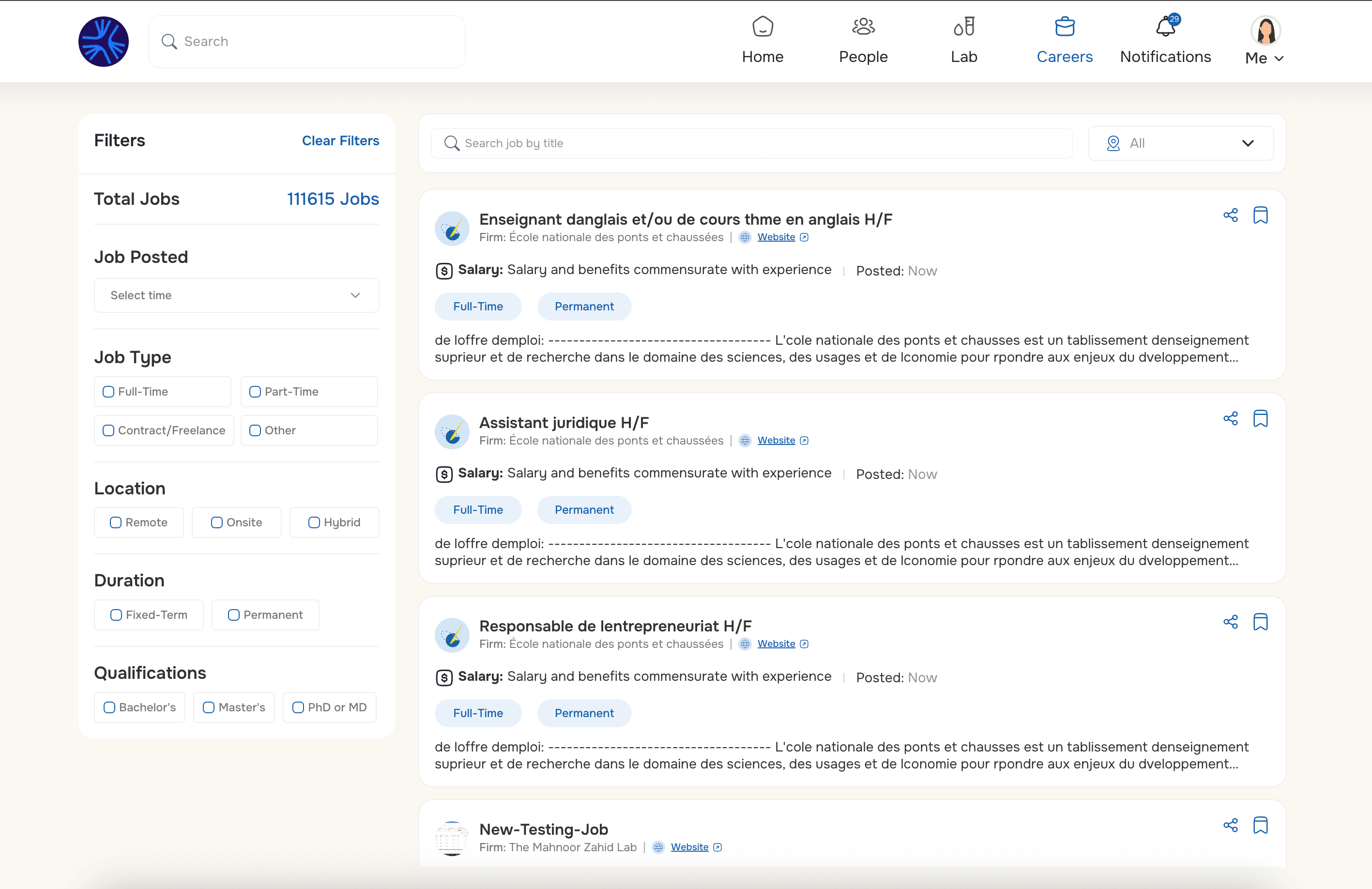
IRIS is a LinkedIn-based platform designed to streamline the discovery, profiling, and engagement of scientists and researchers by aggregating and structuring data from multiple sources. It features a Labs module to organize research institutions and communities, detailed People Profiles that provide a unified view of scientists’ work and expertise, and a Careers module to track academic and professional journeys. The platform also includes a built-in messaging system for seamless communication and a notifications module to keep users updated in real time. Overall, IRIS serves as a centralized, data-driven ecosystem that enhances research visibility, networking, and collaboration.
Overview
Improving Data Accuracy in IRIS
Scope, timeline, and context—how the work was framed before a single sprint shipped.
IRIS aggregates scientist data from multiple external platforms using scraping pipelines. This data powers core features like profiles, labs, and careers.
Organization
Confidential
Duration
On Going
Project type
Web & Mobile Application
Role
QA Engineer
Case study
How we got there
From constraint to release: the problem, the approach, the build, and what changed after go-live.
The problem
The scraped data was: 1- Inconsistent (different formats across sources) 2- Incomplete (missing fields like affiliations or publications) 3- Duplicated (same scientist appearing multiple times) This directly affected: 1- Profile reliability 2- Search accuracy 3- User trust
The approach
1- Implemented data validation rules for name standardization, institution mapping, and field completeness 2- Cross-verified scraped data with source platforms to ensure accuracy 3- Performed database testing using SQL to detect duplicates and validate relationships (profile, lab, career) 4- Ensured referential integrity across all interconnected modules 5- Conducted ETL testing to validate data extraction, transformation logic, and loading without corruption 6- Designed deduplication test cases to verify profile merging and conflict resolution logic
The solution
Implemented a multi-layer QA strategy focused on data accuracy and consistency across the pipeline. Established validation rules for standardizing names, institutions, and mandatory fields, along with automated checks during data ingestion. Strengthened database validation using SQL to detect duplicates and enforce relationships between profiles, labs, and careers. Conducted end-to-end ETL testing to ensure correct extraction, transformation, and loading of data. Additionally, introduced deduplication logic testing to validate profile merging and resolve conflicting data from multiple sources.
Product views
Improving Data Accuracy in IRIS
Interface moments that show hierarchy, density, and polish—the same bar we bring to stakeholder reviews.
Results
The result
This structured QA approach significantly improved data reliability and strengthened user trust in the platform.
The platform achieved higher data accuracy and consistency across all modules. Duplicate profiles were minimized, and relationships between entities such as scientists, labs, and careers became more reliable. Overall, the quality of aggregated data improved, leading to a better user experience and more trustworthy profiles.
Duplicate Reduction
30–50%
Reduced redundant profiles through deduplication and merge validation
Data Accuracy
~40%
Improved correctness of key fields using validation rules and cross-checks
Production Bugs
35%
Decreased data-related issues after ETL and database testing
Manual Effort
~50%
Reduced manual data cleanup through automation and validation
Next step
Want a build like this?
We scope in milestones, ship in slices, and keep communication crisp—so your roadmap stays honest.